Some of the most influential innovations in modern science are nearly invisible to the public. They operate behind the scenes, inside fermentation tanks and research laboratories, quietly transforming entire industries.
One of those innovations is the Pichia Pastoris Expression System, a yeast-based system used worldwide to manufacture recombinant proteins. One of the scientists who played the instrumental role in unlocking its potential was Dr. James “Jim” Cregg.
A founding professor at Keck Graduate Institute (KGI), Cregg spent over four decades developing the yeast expression system that is now widely used in industrial and biopharmaceutical protein production worldwide — from food and manufacturing enzymes to specialty proteins used in products like the Impossible Burger, as well as an important number of therapeutic applications. His work is cited in more than 31,000 research papers and adopted by hundreds of biotechnology companies worldwide.
But Cregg’s influence extends well beyond the laboratory.
At KGI, he helped shape an academic culture where science and business converge and where students are encouraged to translate discovery into real-world impact.
Now, following Cregg’s passing in September 2025, a $1 million endowment from the Frederick Gardner Cottrell Foundation — the corporate foundation of Research Corporation Technologies (RCT) — will ensure that his influence continues for decades to come.
“KGI is proud to continue Dr. Cregg’s legacy through this generous gift from the Frederick Gardner Cottrell Foundation,” said President Mohamed Abousalem. “His passion and dedication to building upon a discovery with a global impact exemplifies the KGI spirit, and as an institution, we are thankful for the role he played in establishing KGI’s academic and scientific foundation.”
The gift establishes the Dr. James M. Cregg Scholars program, providing annual scholarships to students in KGI’s Master of Engineering in Biopharmaceutical Processing (MEng) and Master of Business and Science in Biotechnology (MBS) programs. A portion of the fund will support professional development, allowing students to present research at conferences and engage with the bioprocessing industry Cregg helped build.
KGI will also name Lab 100 in the 535 Building the “Dr. James M. Cregg Laboratory Established by Research Corporation Technologies (RCT) and the Frederick Gardner Cottrell Foundation,” creating a permanent space dedicated to the hands-on scientific training he championed.
From Waste Gas to Wonder Drug
The origins of the Pichia Pastoris Expression System trace back to an unlikely place: the oil fields.
During the 1970s, petroleum companies routinely flared off excess natural gas at wellheads. Phillips Petroleum explored whether methane, converted into methanol, could be used to grow yeast as an inexpensive protein source for animal feed.
After screening yeast strains from around the world, Pichia pastoris emerged as a promising candidate, capable of growing to exceptionally high densities in industrial fermenters.
In the early 1980s, Phillips partnered with the Salk Institute of Biotechnology Industrial Associates (SIBIA) to explore genetic engineering approaches that might add commercial value to the yeast platform. Cregg led the molecular biology work that would later prove pivotal for transforming Pichia pastoris into a recombinant protein production system.
“One of many contributions Jim made was the development of a transformation system, the process to insert foreign DNA into Pichia, and then improving that process in later years,” said Knut Madden, who co-founded BioGrammatics, Inc. with Cregg in 2008 and worked alongside him for decades.
Those “tools” and processes became the foundation for a broader scientific effort that transformed the yeast into a powerful expression platform with unique advantages over bacterial and mammalian hosts. Unlike bacterial hosts, Pichia can properly fold complex proteins. And, unlike mammalian cell cultures, it grew rapidly and inexpensively in fermentation tanks.
In 1993, RCT acquired the Pichia pastoris intellectual property from Phillips. Soon after, Invitrogen commercialized the technology as laboratory “kits,” making the system widely accessible to researchers — an approach supported both by RCT’s licensing strategy and by Cregg’s belief that the platform should be broadly available.
“Jim did not want it hidden as a trade secret,” Madden said. “Instead, he wanted to democratize the technology. Once it was available to researchers everywhere, the publication rate skyrocketed.”
Today, products produced using Pichia include therapies such as Kalbitor for hereditary angioedema, Vyepti for chronic migraines, and Corbevax, an affordable COVID-19 vaccine. Industrial applications range from enzymes in cheese production to plastic-degrading proteins developed for environmental remediation.
“Jim was responsible for the science behind this recombinant expression system,” said Shaun Kirkpatrick, president of RCT. “His work elevated Pichia into one of the workhorse platforms in biotechnology.”
Cregg also helped organize the first, and most of the following, international Pichia conferences, helping build a global community of researchers affectionately known as the “Pichia people.”
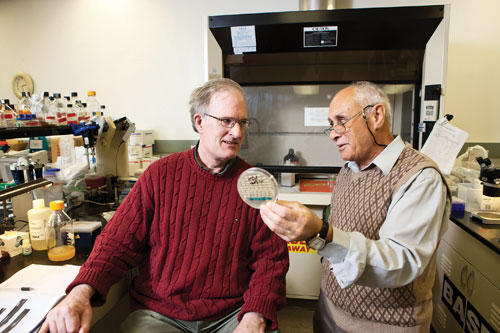
Dr. Jim Cregg and Dr. Ilya Tolstorukov of Keck Graduate Institute developed an innovative platform for producing full-length, multi-chain antibodies using Pichia pastoris.(Photo credit: Genengnews.com)
Building a New Kind of Graduate Institute
When KGI was founded in 1997, Cregg joined as one of its founding members.
The Institute’s mission — training applied life scientists who could bridge discovery and commercial application — aligned naturally with his career. Cregg had already worked across industry and academia, maintaining close relationships with companies developing products based on his research.
“Jim contributed tirelessly to the teaching, research, and corporate interactions that formed the founding pillars,” said former KGI President Sheldon Schuster. “He was always willing to contribute to make the institution more successful.”
Colleagues recall both his scientific rigor and his pragmatic instincts.
Animesh Ray, W.M. Keck Foundation Professor of Systems, Computational, and Molecular Biology, remembers a faculty meeting in the early 2000s where an ambitious plan for a new research building was unveiled.
“We were captivated, already mentally moving into our sunlit offices,” Ray said. “Jim sat quietly the entire time, a faint smile playing on his lips. When the presentation ended and the excitement peaked, he finally leaned back and made the only comment that mattered: ‘Show me the money.’”
Overall, he left a lasting mark on the institution.
“He helped design our world-class interdisciplinary science curriculum,” said Steven Casper, director of the Master of Business and Science in Biotechnology (MBS) program. “Jim was also a champion of research at KGI and helped foster collaboration across disciplines. Above all else, he was a valued member of the faculty. One could always come to him for advice and mentorship.”
A “Hotel for Scientists”
For many colleagues, the memories that stand out most are personal.
When Russian scientist Ilya Tolstorukov relocated to Claremont in 2001, he reached out to Cregg about opportunities to continue his research. Cregg immediately offered him a position as a visiting researcher at KGI — and even hosted him in his home while he settled in.
“When we arrived, we stayed with Jim and his family for several days, maybe weeks,” Tolstorukov recalled. “Jim’s house was like a hotel for scientists coming to the KGI.”
The two first met in the 1980s when Cregg traveled to Russia after learning about Tolstorukov’s work on Pichia genetics. Their families remained close for decades.
“Jim and his wife, Jeannie, were always supporting people and sharing knowledge,” Tolstorukov said.
Students experienced that same generosity.
Tiffany O’Brien ’02, a member of KGI’s inaugural class, remembers how he supported her when it came to navigating dense scientific literature.
“Dr. Cregg created an environment that helped me to feel safe and comfortable to engage, ask questions, and make sense of the science in these papers,” she said. “He had high expectations of his students, and he motivated me to want to learn more.”
Even his nickname — “Pichia Pete” — became a source of good-natured humor.
Science as the Family Language
At home, science was simply part of daily life.
Jim’s son, James Cregg, grew up surrounded by laboratories and experiments. By elementary school, he was already absorbing concepts most students wouldn’t encounter for years.
“When I was six, my class was assigned to write a children’s book,” he said. “Mine was about the asexual reproduction of yeast.”
By his early teens, he was helping in his father’s laboratory and assisting with simple experiments.
Those experiences shaped his career. Today, he works in laboratory automation, designing robotic systems that perform biological experiments.
“My dad was incredibly charismatic and loved teaching,” he said. “But he really, really loved talking about science.”
Cregg also had interests beyond the laboratory — he played football in high school and college, pick-up basketball behind the SIBIA labs, and volleyball on the beach; he even organized a biotech softball league.
Investing in the Next Generation
When leaders at RCT considered how to honor Cregg’s legacy, they focused on something he valued deeply –– supporting future scientists.
“Jim was a pioneer,” Kirkpatrick said. “And we've always felt that KGI is a unique place that trains people for the biotech workforce.”
The Dr. James M. Cregg Scholars program will award scholarships to students demonstrating both academic excellence and leadership potential in biotechnology and bioprocessing. Additional funding will support conference travel and professional development.
“We’re interested in people who will lead the next wave of biotech,” Kirkpatrick said.
He also hopes to involve Cregg’s former students and colleagues in mentoring the scholars.
“I know a lot of people would step up to do that in Jim’s name,” he said.
The announcement of the scholarship program coincides with an international conference of the Pichia community, sponsored by RCT in Spain, where scientists will gather to share advances in the field.
A Living Legacy
Cregg’s work on Pichia pastoris produced more than publications and commercial products. It helped establish a model for how academic research can shape entire industries while remaining collaborative and accessible.
His legacy now lives on in many forms –– in the laboratories around the world using the expression systems he pioneered, in the therapies produced through those technologies, and in the students who will carry his name as Dr. James M. Cregg Scholars and inherit an example of curiosity, generosity, and a lifelong commitment to discovery.
For more information about how you can support Cregg’s legacy, visit: https://www.kgi.edu/give/cregg-memorial/.