KGI 2026 Professional Achievement Award Recipient
Jenny Sheng ’09 has built her career around one question: What does treatment look like from the patient’s side?
As founder and CEO of Innomaven Consulting, Sheng helps pharmaceutical and healthcare organizations bring the patient perspective into decisions traditionally centered on physicians, payers, and regulators.
Her work spans product development, clinical trials, launch strategy, and access. The primary goal is to understand the full experience of the person who ultimately has to live with the treatment.
For her entrepreneurial leadership and work advancing patient-centered innovation in the life sciences, Sheng has been named a recipient of Keck Graduate Institute’s 2026 Professional Achievement Award.
Seeing the Patient Experience Differently
Sheng’s perspective on patient experience took shape during her years at major pharmaceutical companies, including Pfizer and Novartis.
While working on a migraine product for Novartis, she watched a competitor take a digital-first approach: patients could consult with a clinician remotely and receive their medication at home within days, rather than waiting months for a neurologist appointment.
“That really opened my eyes,” Sheng said. “The market leaders are often the ones innovating on the patient experience. If you stagnate there, you get left behind.”
Sheng uses patient experience (PX) to describe the journey surrounding a treatment, beginning with diagnosis and extending well beyond a prescription. It can include how patients access treatment, manage costs, and live with the condition.
That broader definition is the foundation of her work at Innomaven, which she launched in 2023.
Putting Patients Into the Process
When working with companies on the decisions that shape a therapy, Sheng may build a patient journey map, conduct interviews, and work with advocacy organizations.
One example is the Target Product Profile (TPP), a framework used early in drug development to define what a successful product should look like. Sheng believes the patient perspective belongs in that conversation from the beginning.
The same concept applies to launch planning. Rather than asking only whether physicians will prescribe a drug or payers will cover it, Sheng asks where patients will encounter friction.
“It’s about getting that firsthand knowledge and hearing directly from the patients,” she said.
When the Patient Voice Changes the Question
That principle becomes especially important in clinical trials, where the measures used to evaluate a treatment can determine whether its benefits are recognized.
Sheng points to Duchenne muscular dystrophy (DMD) as an example. During an FDA review of a DMD therapy, parents organized a demonstration outside the agency in which boys with the disease played football to show improvements their families had witnessed that were not captured by the trial data.
For Sheng, the episode illustrates why patients need a voice in defining meaningful clinical endpoints. A change that may look modest through a conventional statistical lens can be life-changing to someone living with a disease.
Another issue is equity. People from communities disproportionately affected by certain diseases can be underrepresented in clinical trials because of socioeconomic and logistical barriers. Decentralized trials have helped, but gaps remain.
The answer, she argues, is not simply recruiting more participants. It is listening to patients and communities about what works for them and incorporating that input into trial design.
“Patients are a critical stakeholder in all of this,” Sheng said.
A $5,000 Pill and a Better Package
Patient experience can matter in seemingly small decisions, too.
While consulting for a pharmaceutical company, Sheng noted how a once-monthly oncology drug was being packaged in the same bottle used for 30-pill regimens. The cost-cutting policy created obvious risks: a single $5,000 pill could be lost while being dispensed.
Manufacturing informed them it was too late to change the packaging. Sheng led a task force that developed a temporary welcome kit with clear instructions, then worked with manufacturing on a blister package designed specifically for the single-dose regimen.
This captures what Sheng sees as the practical value of patient experience: identifying problems while there is still time to solve them.
The KGI Foundation
Sheng’s approach draws from her education in KGI’s Master of Business and Science (MBS) program. Gary Cohen’s bioethics course helped her consider the human consequences of scientific decisions, while Steven Casper’s industry-focused courses steered her toward commercial strategy and marketing.
Today at Innomaven, she blends these distinct perspectives by feeding patient research directly into product strategy, commercialization, and access.
She also traces her multidisciplinary instinct to KGI, which proves particularly valuable as she moves among departments that typically operate in separate silos within large pharmaceutical organizations.
“Jenny exemplifies the values of a KGI graduate through her entrepreneurial spirit, interdisciplinary approach, and ethical leadership,” said KGI Alumni Advisory Board Member Hans Smith. “By integrating patient perspectives into the heart of science and business, she is reshaping the industry and carrying forward the KGI mission of innovation and collaboration with lasting impact.”
The Work Ahead
Sheng was named a 2024 Women in Innovation Movers and Makers winner and received a Marie Curie Award for Innovation from the Healthcare Businesswomen’s Association. She also serves as deputy chair of the HBA Patient Centricity Affinity Group and recently developed an Industry Guide to Patient Centricity.
“The recognition is a signal for me to keep pushing, not only for myself but on behalf of patients,” Sheng said.
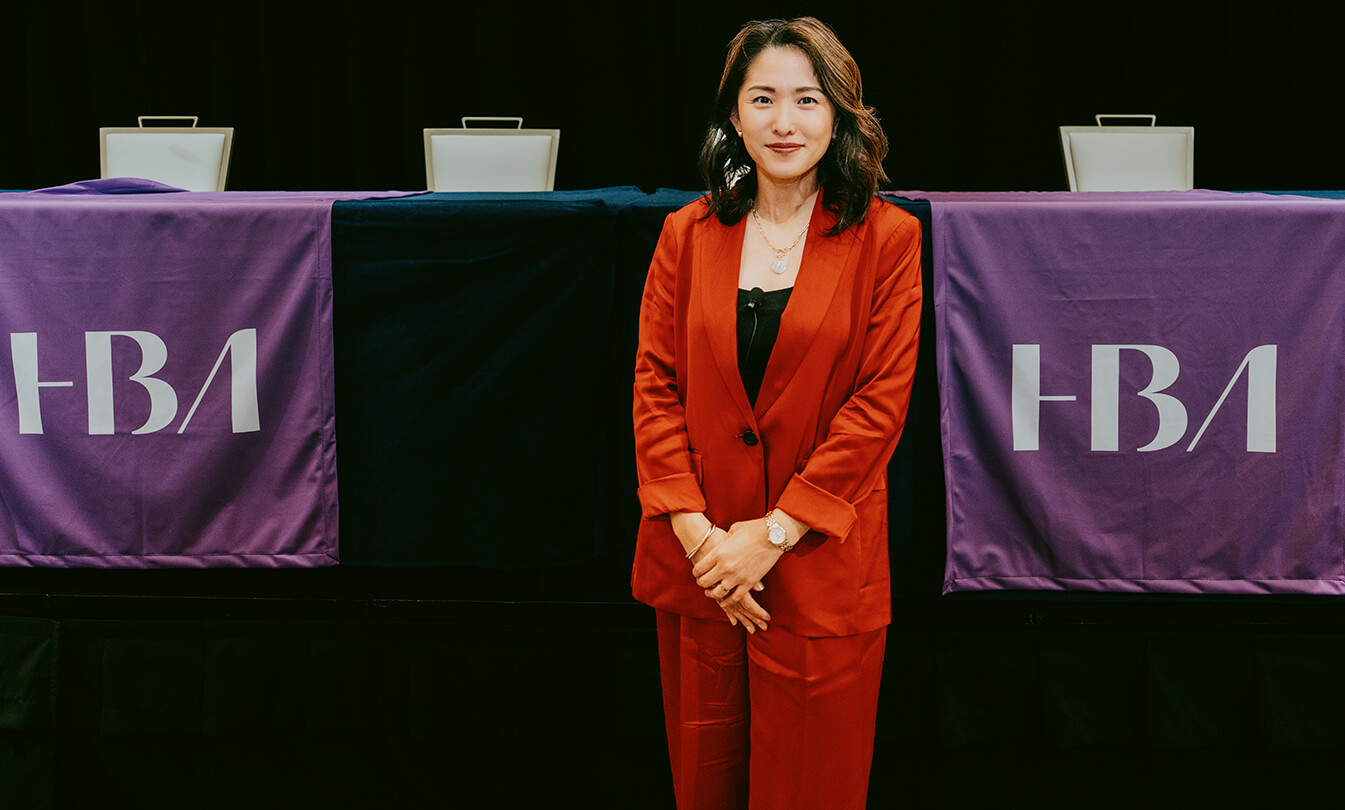
Jenny Sheng at HBA Conference
She hopes more pharmaceutical companies will routinely include patients when they define their customers and gather patient insights throughout a product’s life cycle. That means asking not only whether a therapy works but what it takes for a person to access it and incorporate it into a life that includes caregivers, work, and family.
Recently, Sheng had a full-circle moment when she and her husband, Li Chen ’07 — whom she met at KGI — returned to campus to speak with incoming MBS students.
“When I spoke to those students, I felt very hopeful about the future and the life science industry becoming more innovative, thoughtful, and inclusive,” Sheng said.
Nearly 20 years after KGI opened her eyes to possibilities beyond the laboratory, Sheng is now trying to open another door for the industry itself: one that puts the patient inside the room from the beginning.